Whey protein is the world's most studied and widely used sports supplement — but its story began thousands of years ago in a very different setting.
Ancient Origins: Whey as Food, Not Sport
Whey protein's story starts not in a gym, but in a kitchen — or more precisely, an ancient cheese-making operation. Whey is the liquid byproduct of cheese production: when milk is curdled and the solid curds are separated, the thin, watery, yellowish liquid that remains is whey.
Ancient civilizations recognized whey's value long before modern nutritional science. Hippocrates, the Greek physician often called the father of medicine, reportedly prescribed whey to his patients around 400 BC as a tonic for health and vitality. For thousands of years across Europe, whey was consumed as a health beverage, fed to livestock, and used in early folk medicine.
In 18th-century Switzerland, "whey cures" at Alpine spas were fashionable among the wealthy. Visitors would travel to mountain towns to drink fresh whey daily, believing it aided digestion, skin health, and general well-being. There was no understanding of protein science behind these practices — just empirical observation that whey seemed to make people feel better. (4)

The Birth of Sports Nutrition: Mid-20th Century
The modern story of whey as a performance supplement begins in the post-World War II era. As interest in physical culture, bodybuilding, and athletic performance grew through the 1940s and 1950s, early entrepreneurs began exploring concentrated protein products.
Irvin Johnson (later known as Rheo H. Blair) is often credited as a pioneer of protein supplementation in the United States. In the 1950s, Blair began developing milk and egg-based protein powders and marketing them to bodybuilders, arguing that dietary protein was the key to building championship physiques. His products were rudimentary by today's standards, but they planted the seed of an industry. (3)
The dairy industry, meanwhile, was grappling with a problem: whey was a byproduct of cheese production that mostly went to waste — dumped, spread on fields, or fed to pigs. Millions of tons of nutritionally valuable liquid were being discarded annually. This inefficiency drove significant research investment into finding ways to capture and concentrate whey's nutritional content.
Scientific Breakthrough: Isolating the Protein
Through the 1960s and 1970s, food scientists developed the technologies necessary to concentrate and isolate whey protein effectively. Ion exchange and microfiltration processes allowed manufacturers to remove excess lactose, fat, and carbohydrates while preserving the protein content — the result was whey protein concentrate (WPC), typically containing 70–80% protein by weight.
Further advances in filtration technology led to the development of whey protein isolate (WPI) — a purer form containing 90% or more protein, with significantly reduced lactose and fat content. For lactose-sensitive athletes and those prioritizing the cleanest possible macros, isolate quickly became the premium tier of whey supplementation.
The third form — whey protein hydrolysate (WPH) — emerged later as pre-digested whey, with peptide bonds partially broken to accelerate absorption. While more expensive to produce, hydrolysate is prized for its rapid delivery of amino acids to muscle tissue.
Supplement Industry Boom: 1980s–2000s
The commercial sports supplement industry exploded in the 1980s and 1990s, fueled by the mainstream popularity of bodybuilding, the emergence of fitness culture, and improving manufacturing technology that made protein powder more affordable and palatable.
Companies launched their first whey protein products in the late 1980's while the 1990s saw rapid product proliferation, flavor innovation, and the first serious academic research into whey's specific performance benefits.
Scientific literature began confirming what athletes had empirically observed for decades: whey protein, thanks to its complete amino acid profile, high leucine content, and rapid digestibility, was extraordinarily effective at supporting muscle protein synthesis. Study after study validated its use for muscle building, recovery, and body composition improvement. (2)
The Modern Era: Quality, Transparency, and Science
Today, whey protein is a multi-billion-dollar global industry and the most extensively researched protein supplement in human history. The science is settled: whey is a highly effective, safe, and versatile tool for athletes and health-conscious individuals alike.
But the industry has also matured in important ways. Modern consumers are increasingly savvy — they read labels, question proprietary blends, and demand transparency about what's in their supplements and where those ingredients come from. The era of marketing hype over formula quality is, slowly, giving way to brands that put their cards on the table.
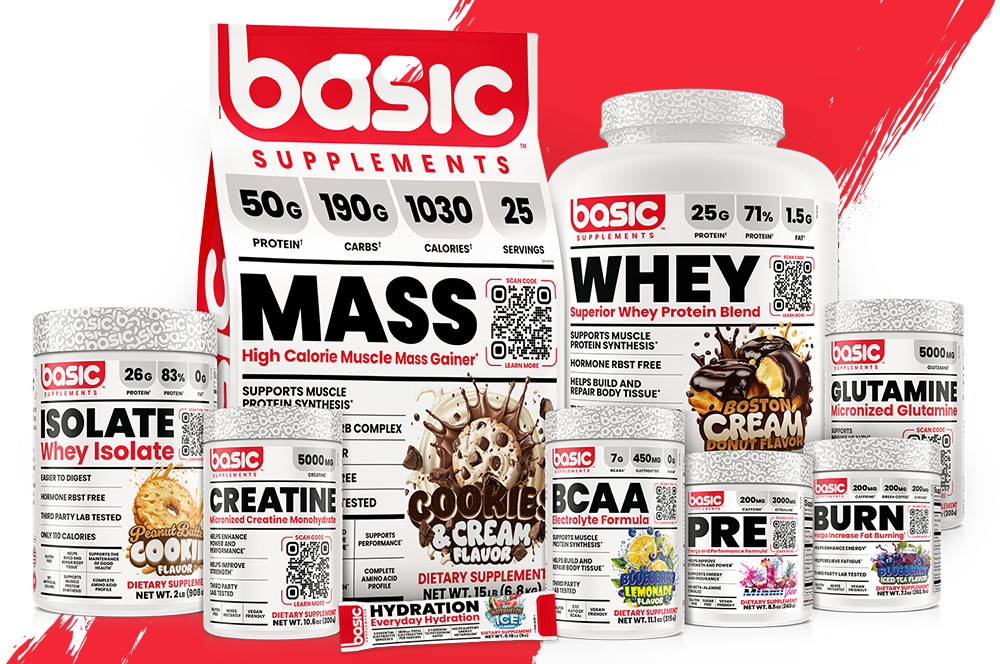
This is precisely the environment in which Basic Supplements was built. Our whey is sourced from Glanbia — one of the world's leading dairy ingredient suppliers, renowned for consistent quality and rigorous testing standards. Every ingredient is listed in full. No hidden blends, no mystery dosages.
The history of whey protein is a story of a once-discarded byproduct becoming the gold standard of sports nutrition. Thousands of years after Hippocrates prescribed it, and decades after bodybuilders first scooped it from giant cans, whey remains exactly what it's always been: the most complete, efficient, and effective protein available.

References
- Haraguchi FK et al. (2006). Whey proteins: Nutritional properties and their use in foods. Ciência e Tecnologia de Alimentos, 26(4), 947–952.
- Ha E, Zemel MB. (2003). Functional properties of whey, whey components, and essential amino acids. Journal of Nutritional Biochemistry, 14(5), 251–258.
- Hulmi JJ, Lockwood CM, Stout JR. (2010). Effect of protein/essential amino acids and resistance training on skeletal muscle hypertrophy. Nutrition & Metabolism, 7, 51.
- Walzem RL, Dillard CJ, German JB. (2002). Whey Components: Millennia of Evolution Create Functionalities for Mammalian Nutrition. Critical Reviews in Food Science and Nutrition, 42(4), 353–375.










 Basic 101